From the Long-view Desk
Does tirzepatide reduce weight mainly because it makes people feel sick? A 2025 analysis of the SURMOUNT-1 through SURMOUNT-4 trials examined that question by comparing weight changes among participants who did and did not report nausea, vomiting, or diarrhea. Substantial weight reduction occurred in both groups. A separate statistical analysis attributed only a small share of the estimated treatment effect to these symptoms, with or without indigestion included.
Those findings argue against treating nausea as proof that treatment is working. But the analysis did not randomly assign people to experience symptoms, and it excluded weight measurements after treatment discontinuation. Understanding those choices is essential: the results describe selected on-treatment experiences and model-based relationships, not a controlled experiment establishing the biological role of nausea. The evidence is more informative when the four trials, symptom definitions, and statistical questions are kept separate.
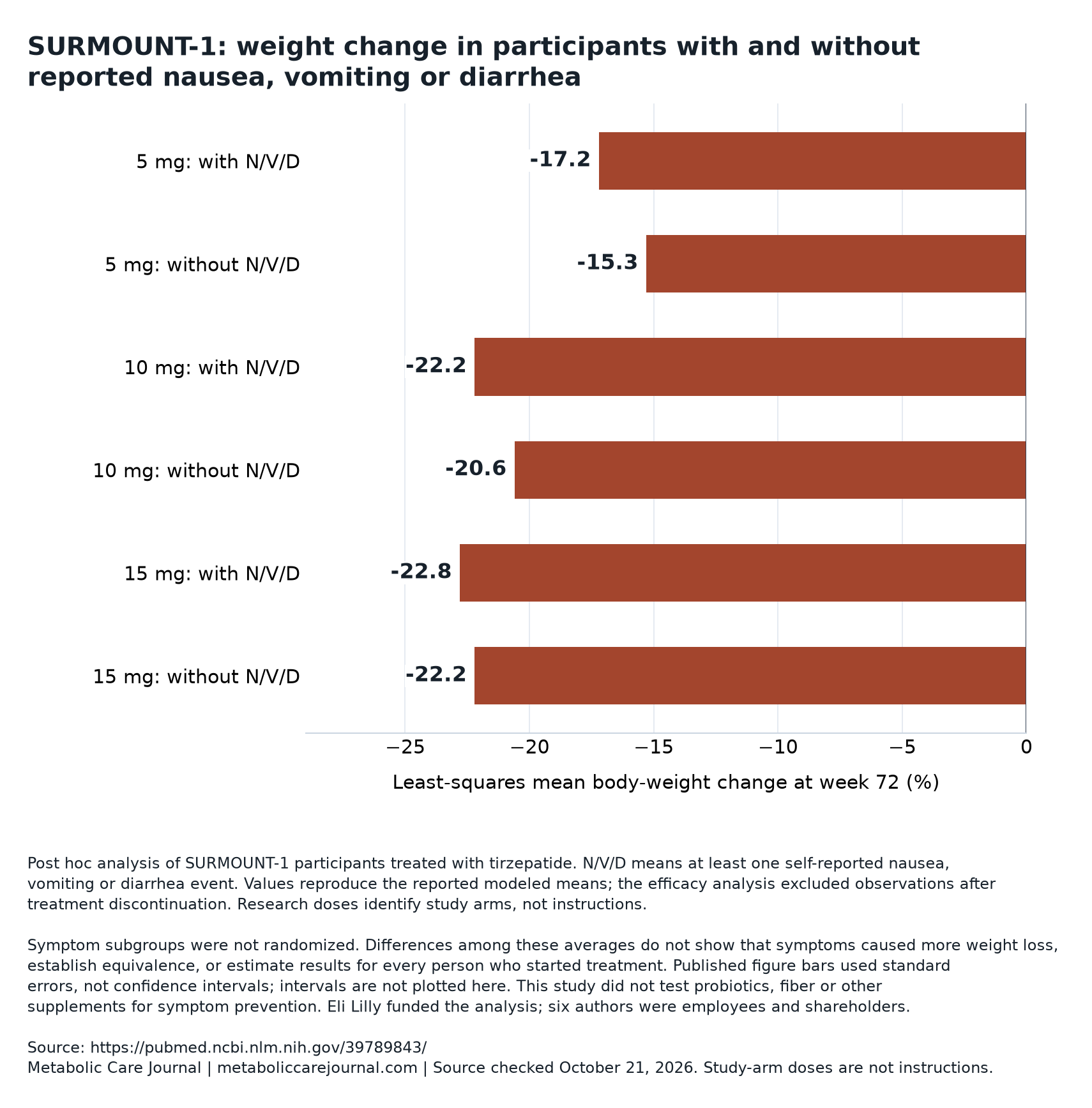
SURMOUNT-1: weight change in participants with and without reported nausea, vomiting or diarrhea
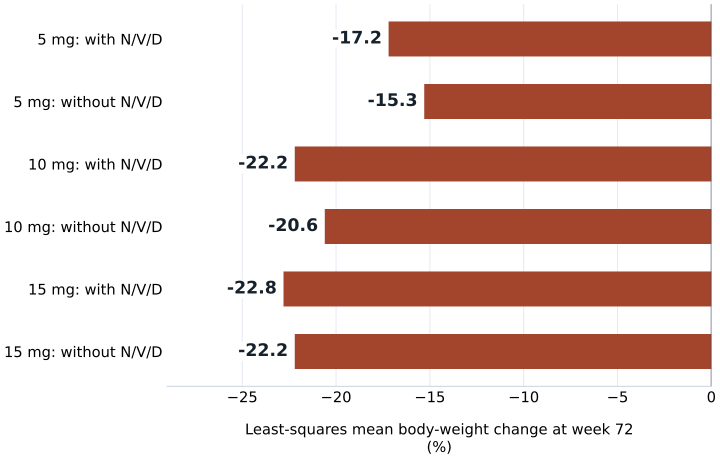
Post hoc analysis of SURMOUNT-1 participants treated with tirzepatide. N/V/D means at least one self-reported nausea, vomiting or diarrhea event. Values reproduce the reported modeled means; the efficacy analysis excluded observations after treatment discontinuation. Research doses identify study arms, not instructions.
Symptom subgroups were not randomized. Differences among these averages do not show that symptoms caused more weight loss, establish equivalence, or estimate results for every person who started treatment. Published figure bars used standard errors, not confidence intervals; intervals are not plotted here. This study did not test probiotics, fiber or other supplements for symptom prevention. Eli Lilly funded the analysis; six authors were employees and shareholders.
Source 1Download the source-labeled chart (PNG) · Download the data (CSV)
| Randomized dose and nonrandomized symptom subgroup | Reported value |
|---|---|
| 5 mg: with N/V/D | -17.2 |
| 5 mg: without N/V/D | -15.3 |
| 10 mg: with N/V/D | -22.2 |
| 10 mg: without N/V/D | -20.6 |
| 15 mg: with N/V/D | -22.8 |
| 15 mg: without N/V/D | -22.2 |
Sections in this article
Four trials asking different treatment questions
SURMOUNT-1, -3, and -4 enrolled adults with obesity, or overweight plus a weight-related condition, without type 2 diabetes. SURMOUNT-2 enrolled adults with overweight or obesity and type 2 diabetes. All compared once-weekly subcutaneous tirzepatide with placebo, alongside lifestyle support. The milligram doses identify research arms, not a personal dosing plan. Known clinically significant gastric-emptying abnormalities and a history of pancreatitis were among the exclusions.
The designs were not interchangeable. SURMOUNT-3 began randomized treatment after a 12-week intensive lifestyle program. SURMOUNT-4 used an open-label tirzepatide lead-in, followed by randomized continuation or withdrawal. Its 88-week total consisted of 36 lead-in weeks plus 52 randomized weeks—not 88 randomized weeks after the lead-in. These differences affect both symptom reporting and weight trajectories, explaining why the investigators generally analyzed trials separately rather than calculating one combined result.
| Trial | Population and treatment comparison | Timing and interpretation |
|---|---|---|
| SURMOUNT-1 | Adults without type 2 diabetes; tirzepatide 5, 10, or 15 mg versus placebo | 72 weeks; multiple fixed-dose arms |
| SURMOUNT-2 | Adults with type 2 diabetes; tirzepatide 10 or 15 mg versus placebo | 72 weeks; a distinct diabetes population |
| SURMOUNT-3 | Adults without type 2 diabetes; maximum tolerated 10 or 15 mg versus placebo | 72 randomized weeks after a 12-week intensive lifestyle program |
| SURMOUNT-4 | Adults without type 2 diabetes; continued maximum tolerated tirzepatide versus switch to placebo | 88 weeks total: 36-week open-label lead-in plus 52-week randomized withdrawal period |
One reported episode determined symptom-group membership
The primary symptom definition was nausea, vomiting, or diarrhea, abbreviated N/V/D. A sensitivity analysis added dyspepsia, meaning indigestion. This is narrower than every gastrointestinal adverse event: someone without N/V/D could still have constipation or another digestive complaint. Consequently, describing the comparison as people with versus without all digestive side effects would overstate what was tested.
Participants reported adverse events in response to open-ended, non-leading questions, and a single event was enough to place someone in the symptom group. That classification combines potentially very different experiences: one brief episode and repeated symptoms can receive the same yes/no designation. Although onset, end date, and severity were collected, systematic symptom-severity scales were not used. The analysis therefore addresses whether a reported event occurred more directly than it addresses cumulative symptom burden, disrupted eating, or day-to-day functioning.
Source 1The weight-loss comparisons show substantial reductions in both groups
The efficacy outcome was percentage change in body weight from baseline to the primary endpoint. Investigators used a mixed model for repeated measurements, which incorporates weight observations across visits to estimate endpoint changes. In SURMOUNT-1, reductions were substantial whether N/V/D was reported or not. The symptom-associated gaps were 1.9, 1.6, and 0.6 percentage points across the three dose arms. These are descriptive differences between post-randomization groups, not additional weight loss proven to result from symptoms.
The pattern extended beyond SURMOUNT-1. In SURMOUNT-2, changes with versus without N/V/D were −14.2% versus −13.1% at 10 mg and −16.8% versus −15.0% at 15 mg. Corresponding changes were −22.0% versus −19.9% in SURMOUNT-3 and −26.3% versus −25.7% over SURMOUNT-4’s full timeline. The published figure uses standard-error bars, not confidence intervals. Numerical confidence limits for these subgroup estimates are not reported in the accessible main-text values, and visual similarity does not establish formal statistical equivalence.
| Tirzepatide study arm | With N/V/D | Without N/V/D |
|---|---|---|
| 5 mg once weekly | −17.2% | −15.3% |
| 10 mg once weekly | −22.2% | −20.6% |
| 15 mg once weekly | −22.8% | −22.2% |
The on-treatment estimand changes whose experience is represented
An estimand is the precise treatment-effect question an analysis aims to answer, including how it handles events such as stopping medication. Here, the efficacy analysis included randomized participants exposed to at least one dose, but excluded measurements after treatment discontinuation. SURMOUNT-2 also excluded measurements after initiation of antihyperglycemic rescue therapy. This differs from asking what happens after assignment to treatment regardless of subsequent treatment changes.
That distinction matters especially for tolerability. If severe symptoms prompt discontinuation, later weight outcomes for those participants do not contribute in the same way as outcomes from people who remain treated. The analysis can therefore favor the experiences of people better able to tolerate treatment. It does not directly estimate the relationship between early symptoms and long-term weight outcomes among everyone who starts. For broader outcome tracking, our guide to progress beyond the scale provides a complementary framework, rather than a substitute for the study’s specified weight endpoint.
Source 1Why random treatment assignment does not randomize nausea
Randomization strengthens the tirzepatide-versus-placebo comparison because treatment assignment is determined by chance. It does not provide the same protection for comparisons between people who later develop symptoms and those who do not. Symptoms arise after treatment begins and may be related to exposure, adherence, individual susceptibility, or other events that also influence weight. Similar baseline characteristics do not eliminate those possible later differences.
For example, greater treatment exposure could plausibly be associated with both symptoms and weight reduction, making symptoms a marker rather than the cause of the reduction. Alternatively, symptoms could change eating temporarily without accounting for most longer-term loss. These are methodological possibilities, not established explanations from this study. The observed comparisons cannot distinguish them cleanly. They support the bounded conclusion that substantial weight loss was observed without reported N/V/D; they do not prove that inducing nausea would improve outcomes or that preventing nausea would leave every outcome unchanged.
Source 1Reading the 3.1% mediation result in the right units
Mediation analysis attempts to divide a treatment effect into an indirect component associated with an intermediate event and a remaining component. Here, the intermediate events were N/V/D, with dyspepsia added in a sensitivity analysis. Mediation was performed in SURMOUNT-1, -2, and -3—not SURMOUNT-4, whose withdrawal design complicated that question. The methods explicitly exclude SURMOUNT-4 despite broader wording in the discussion.
The estimated mediated shares ranged from −0.7% to 2.5% in SURMOUNT-1, 0.8% to 2.0% in SURMOUNT-2, and 1.5% to 3.1% in SURMOUNT-3. These percentages describe a share of the total estimated effect. For a hypothetical treatment difference of 20 percentage points, a 3% mediated share would equal 0.6 percentage points, not three. That arithmetic illustrates the units; it is not a new trial estimate. The slightly negative estimate should not be read as proof that symptoms protect against weight loss; estimates near zero can vary around zero.
Source 1A small modeled pathway leaves the biological mechanism unresolved
Mediation estimates require stronger assumptions than a randomized treatment comparison alone. In particular, factors linking symptoms to weight must be adequately addressed. The authors acknowledge that these analyses were not adjusted for potential post-randomization confounders. They were exploratory and not controlled for multiplicity, meaning multiple analyses were performed without adjustment to limit false-positive findings across them.
Timing is another unresolved issue. Most symptoms occurred early during escalation, whereas weight change was assessed much later. A yes/no symptom measure does not fully represent whether symptoms preceded reduced intake, recurred, or resolved while weight continued falling. Gastric emptying was not explored as a mechanism, and the study cannot identify what proportion of the remaining effect came from appetite signaling or other pathways. More informative future analyses would connect repeated symptom measurements, treatment exposure, eating behavior, and weight over time. Even then, causal interpretation would require explicit assumptions rather than relying on the apparent consistency of group averages.
Source 1Tolerability includes treatment interruptions and departures
Across tirzepatide arms and trials, 27.8%–72.8% reported at least one GI adverse event, compared with 12.2%–32.5% on placebo. These broad ranges reflect different populations, doses, and designs; their endpoints should not be combined into one risk difference or relative risk. Most events were mild to moderate and occurred during dose escalation, but severe or serious GI events were reported in 0.3%–5.6% of participants. Severe intensity and medical seriousness are related but distinct classifications.
Stopping medication was also different from leaving research follow-up. GI events led 1.0%–10.5% of tirzepatide-treated participants to discontinue treatment, while 0%–2.2% discontinued the study for GI reasons. Thus, continued study participation does not demonstrate continued medication tolerance. Interpretation for care arrangements: a useful question is how symptom contacts and follow-up are documented, not whether a service promises trial-like results. Our support-planning guide and Form Health review can help readers check support descriptions and documentary terms; neither establishes availability of the studied product or condition-specific outcomes.
Source 1Symptom medication use was observed, not experimentally tested
In SURMOUNT-1 through -3, 5.2%–9.3% of tirzepatide-treated participants reported use of one antidiarrheal medication, versus 1.2%–2.2% with placebo. One antiemetic medication was reported by 13.8%–27.5%, versus 5.8%–6.7%. First use was most common during the first 24 weeks, encompassing escalation. These findings describe the supportive treatment environment surrounding the weight results.
They do not establish the effectiveness of a particular symptom remedy. Investigators selected treatments as needed; participants were not randomized to symptom-management strategies. People receiving rescue medication may have differed in symptom severity and other ways. Likewise, dietary counseling was not a randomized test of a specific food routine, fiber product, or probiotic. Our food-routines guide addresses practical planning, not a prevention strategy proven by SURMOUNT. Interpretation for contracts: the Noom Med review can be used to check written service terms, without inferring studied-product access, symptom-treatment efficacy, or equivalent clinical monitoring.
Source 1Parallel semaglutide findings and current safety context
A separate STEP analysis offers a similar qualitative pattern, not a head-to-head comparison. Among semaglutide-treated participants, weight reductions were substantial with and without GI events, and mediation attributed less than one percentage point of the semaglutide-versus-placebo weight difference to GI events. That absolute unit differs from SURMOUNT’s percentage share. Our separate STEP explanation examines the distinctions. Neither report establishes comparative tolerability between drugs, and injectable results do not automatically transfer to oral formulations, compounded products, or providers.
Current Zepbound labeling reports severe GI reactions in a separate two-trial pool: 1.7%, 2.5%, and 3.1% at 5, 10, and 15 mg, versus 1% with placebo. Both Zepbound and Wegovy labels warn about dehydration-related kidney injury, pancreatitis, gallbladder disease, and delayed gastric emptying, and neither is recommended in severe gastroparesis. Persistent or severe abdominal pain, repeated vomiting, or symptoms suggesting dehydration warrant prompt clinical assessment rather than being treated as evidence of efficacy. Patients should also inform procedural teams about treatment because of aspiration concerns; these analyses do not establish a medication-withholding schedule.
Source 1 Source 2 Source 3 Source 4Questions about the evidence
Does having no nausea mean tirzepatide is not working?
No. Substantial average weight reductions occurred among participants without reported nausea, vomiting, or diarrhea. Symptoms were not validated as a test of treatment response. Individual effectiveness still requires assessment over time; the absence of nausea alone does not establish success or failure, and experiencing nausea does not establish a better outcome.
Source 1Were the symptom and no-symptom groups equivalent?
The investigators described broadly similar weight reductions, but that is not a formal equivalence finding. Participants were not randomized into symptom groups, and some numerical differences remained. Establishing equivalence would require a defined acceptable difference and an appropriate statistical analysis, not simply overlapping-looking bars or substantial loss in both groups.
Source 1Does the analysis rule out an effect of slower gastric emptying?
No. Gastric emptying was not evaluated as a mechanism, and people with known clinically significant gastric-emptying abnormalities were excluded. Reported nausea is not a direct measurement of stomach emptying. Current labeling states that tirzepatide delays gastric emptying, so the symptom analysis should not be interpreted as overturning that pharmacologic effect.
Source 1 Source 3Does treating nausea reduce the weight-loss benefit?
This analysis cannot answer that causally. Symptom medications were allowed and their use was described, but symptom treatment was not randomly assigned. The findings provide no reason to regard untreated nausea as a necessary therapeutic goal, yet they do not quantify how a particular antiemetic changes weight, adherence, or longer-term outcomes.
Source 1Who funded the analysis, and how should that affect its interpretation?
Eli Lilly funded the study, and six authors were company employees and shareholders. Other authors disclosed industry relationships. These ties do not invalidate the findings, but they reinforce the value of examining the methods, selection rules, and uncertainty directly. Independent replication using richer symptom measurements would strengthen confidence in the mechanistic interpretation.
Source 1Editorial assessment
The most persuasive finding is that substantial tirzepatide-associated weight reduction occurred without reported N/V/D across several trial settings. The mediation results support a small modeled symptom-related pathway, but they do not prove biological independence from digestive effects. For public interpretation, nausea is neither a necessary marker of effectiveness nor a symptom to dismiss. The remaining scientific task is to separate drug exposure, appetite changes, gastrointestinal physiology, symptom treatment, and selective treatment continuation using measurements that preserve their timing.
Research access and limitations
This explanation uses the full primary post hoc reports and their accessible main-text methods and results, plus selected current official DailyMed label sections. Supplementary tables, original trial protocols, and the complete prescribing information were not independently examined. Numerical confidence intervals unavailable in the accessible text are not reconstructed from standard-error figures. The analysis is exploratory, relies on self-reported symptoms and selected on-treatment weight data, and does not establish individual treatment effects or current prescribing instructions.
Source notes
Scientific sources checked October 21, 2026. Earlier research and provider sources retain their dated histories below. Provider pages document advertised terms. Study summaries identify the scope of our review.
- Gastrointestinal tolerability and weight reduction associated with tirzepatide in adults with obesity or overweight with and without type 2 diabetes in the SURMOUNT-1 to -4 trials.Full primary post hoc report, Methods, Results, main Table 1 and Discussion/funding reviewed; supplementary tables and source-trial protocols not separately reviewed. · Checked 2026-10-21
- Gastrointestinal tolerability of once-weekly semaglutide 2.4 mg in adults with overweight or obesity, and the relationship between gastrointestinal adverse events and weight loss.Full primary post hoc analysis main text and main Table 1 reviewed; supplementary file and original trial protocols not independently reviewed. · Checked 2026-10-21
- DailyMed: ZEPBOUND tirzepatide current prescribing informationCurrent official DailyMed label, updated August 28, 2026, current archive September 2, 2026; indications, relevant safety sections 5.2 through 5.5 and 5.9, postmarketing experience and oral-drug interaction sections reviewed. Other sections not fully reviewed. · Checked 2026-10-21
- DailyMed: WEGOVY semaglutide current prescribing informationCurrent official DailyMed label, updated June 18, 2026, current archive June 30, 2026; indications, relevant safety sections 5.2, 5.3, 5.5, 5.6, 5.10, postmarketing experience and oral-drug interaction sections reviewed. Other sections not fully reviewed. · Checked 2026-10-21