From the Long-view Desk
Nausea and weight loss often occur together during semaglutide treatment, but that does not establish that nausea causes the weight loss. An exploratory analysis of the STEP trials examined this distinction using adverse-event records, observed weight changes, and statistical mediation models. Digestive symptoms were substantially more common with semaglutide than placebo. Nevertheless, participants without reported gastrointestinal adverse events also lost considerable weight.
The central finding is narrower than a proven biological mechanism: less than one percentage point of the modeled semaglutide-versus-placebo difference in weight change was attributed to recorded gastrointestinal events. Understanding that result requires attention to who entered each analysis, how symptoms were counted, and what the models assumed. The full primary report supports a useful explanation of tolerability, but not a claim that symptoms are harmless, necessary for success, or completely unrelated to weight change.
STEP 1–3: common gastrointestinal events with semaglutide or placebo
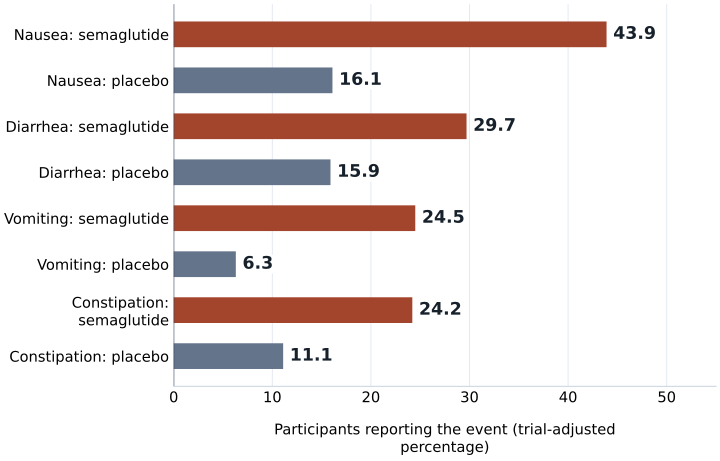
This post hoc analysis pooled three 68-week trials with 2,117 participants randomized to weekly subcutaneous semaglutide 2.4 mg and 1,262 to placebo. Percentages were adjusted across trials using Cochran–Mantel–Haenszel weights. Events were considered on treatment if a dose had been administered in the preceding 49 days.
A person could report more than one event, so percentages must not be added. These are cumulative event proportions, not weekly symptom prevalence or estimates for a current oral formulation. Confidence intervals were not supplied for these percentages in the reviewed main report. Severe GI events occurred in 4.1% versus 0.9%; common does not mean every event is harmless. Novo Nordisk funded the trials and writing assistance.
Source 1Download the source-labeled chart (PNG) · Download the data (CSV)
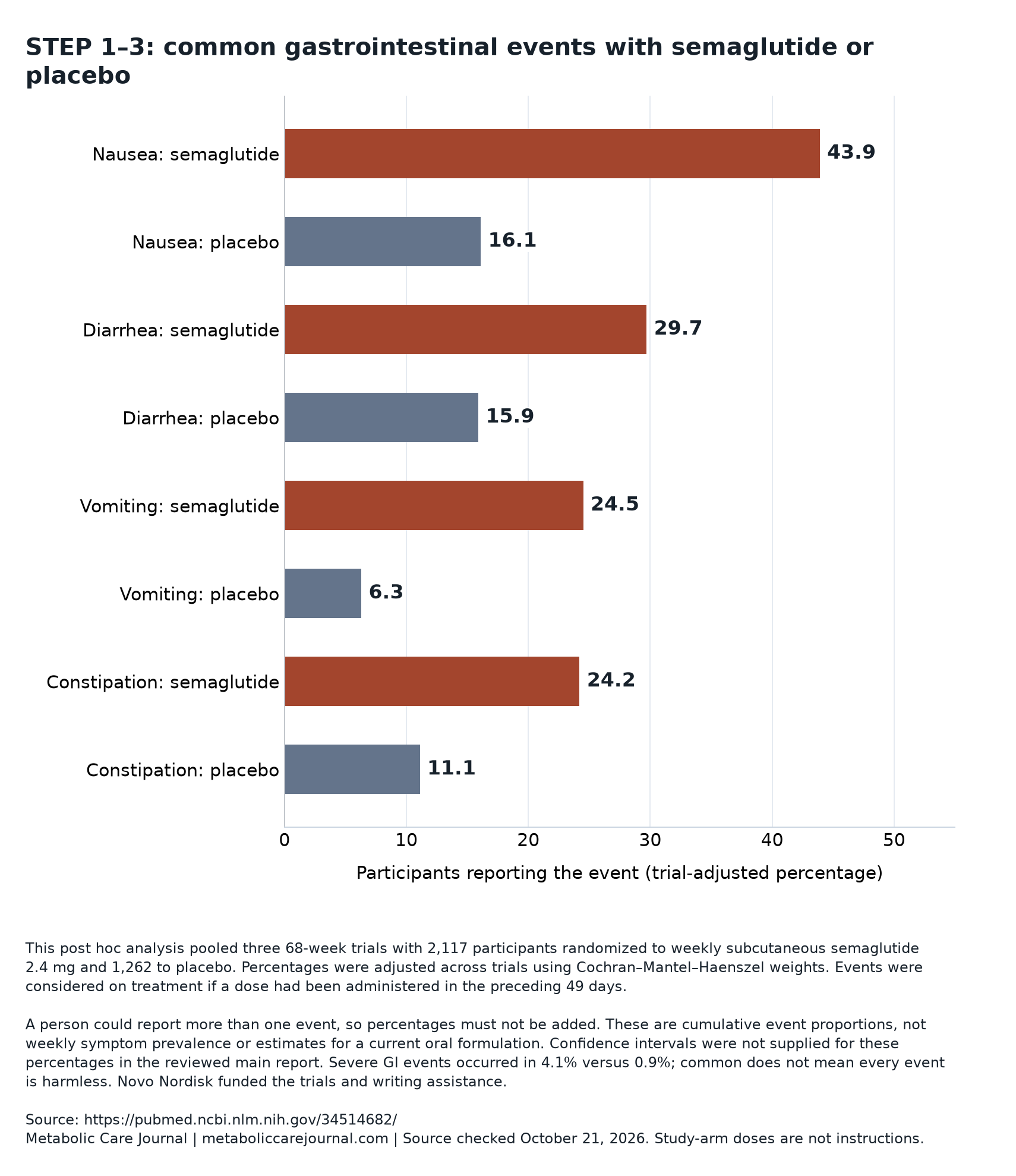
| Event and randomized assignment | Reported value |
|---|---|
| Nausea: semaglutide | 43.9 |
| Nausea: placebo | 16.1 |
| Diarrhea: semaglutide | 29.7 |
| Diarrhea: placebo | 15.9 |
| Vomiting: semaglutide | 24.5 |
| Vomiting: placebo | 6.3 |
| Constipation: semaglutide | 24.2 |
| Constipation: placebo | 11.1 |
Sections in this article
An exploratory analysis built from three different trials
This was not a new trial assigning people to experience nausea. Investigators conducted post hoc analyses—analyses developed after the original trial plans—using STEP 1–3 data. These trials randomized adults to once-weekly subcutaneous semaglutide 2.4 mg or placebo for 68 weeks. The dose identifies the studied treatment arm, not an individualized treatment recommendation. Gastrointestinal adverse-event incidence was a supportive secondary safety endpoint in the original trials.
STEP 1 and STEP 3 enrolled adults without diabetes who had obesity, or overweight with a weight-related condition. STEP 2 enrolled adults with type 2 diabetes and a body mass index of at least 27. Background support also differed: STEP 3 used intensive behavioral therapy, whereas STEP 1 and STEP 2 used lifestyle intervention. Similar treatment duration permitted pooling, but the populations were not interchangeable.
The investigators adjusted pooled symptom percentages for differences between trials using Cochran–Mantel–Haenszel weights. Consequently, dividing the raw symptom counts by the combined participant totals does not exactly reproduce the published adjusted percentages. This distinction matters when checking the arithmetic: the headline incidence estimates are weighted summaries, not simple fractions of the pooled sample.
Source 1What the symptom percentages actually count
At least one gastrointestinal adverse event was reported by an adjusted 72.9% of semaglutide participants and 47.1% of placebo participants. The difference is 25.8 percentage points, calculated by subtraction. It describes an absolute difference in cumulative symptom reporting during the analysis window, not a hazard ratio, a weekly probability, or the proportion continuously ill.
Nausea showed the largest absolute difference among the four most common symptoms: 27.8 percentage points. Vomiting differed by 18.2 points, diarrhea by 13.8 points, and constipation by 13.1 points. These calculations help distinguish the frequency of a symptom from its excess frequency over placebo. Substantial placebo reporting also shows why every digestive complaint during treatment cannot automatically be attributed to the drug.
The table categories overlap because one participant could report several symptoms. Adding the four percentages would count some people repeatedly. Likewise, having any gastrointestinal event does not tell us how often it recurred or how disruptive it was. The trial report separates those questions through event duration, severity, and treatment changes.
| Reported event | Semaglutide 2.4 mg | Placebo |
|---|---|---|
| Any gastrointestinal event | 72.9% | 47.1% |
| Nausea | 43.9% | 16.1% |
| Diarrhea | 29.7% | 15.9% |
| Vomiting | 24.5% | 6.3% |
| Constipation | 24.2% | 11.1% |
Early clustering did not mean all symptoms ended quickly
Symptoms occurred most frequently during or shortly after dose escalation. The historical trial protocol increased treatment over an initial 16-week period, and the cumulative curve for first gastrointestinal events largely plateaued after about week 20. A plateau in first events means fewer previously unaffected participants were beginning to report symptoms; it does not mean later events disappeared.
Weekly prevalence—the proportion experiencing a symptom at a particular time—answers a different question from cumulative incidence. Nausea, diarrhea, and vomiting prevalence peaked around week 20 and subsequently declined, although each remained elevated relative to placebo across treatment. Recurrent symptoms in people who had already reported an event can maintain prevalence without greatly increasing the first-event curve.
Estimated median individual-event durations with semaglutide were eight days for nausea, three for diarrhea, and two for vomiting. Constipation was different: its median duration was 47 days, compared with 35 days on placebo. These Kaplan–Meier estimates summarize recorded episodes, not a person's total symptom burden. They are also not recommended waiting periods before seeking assessment. A median describes a distribution; it does not predict when an individual's symptoms will resolve.
Source 1Mild events and meaningful treatment disruption coexisted
The often-cited reassuring figures use events, not people, as their denominator: 99.5% of gastrointestinal events with semaglutide were classified as nonserious, and 98.1% as mild or moderate. A person could contribute multiple events. Those percentages therefore cannot be translated into claims that 99.5% of participants were unaffected or that severe symptoms were virtually absent.
Severity and seriousness are also different classifications. Severity describes symptom intensity; seriousness concerns defined medical consequences. Severe gastrointestinal events, including nausea, abdominal pain, diarrhea, and vomiting, occurred in 4.1% of semaglutide participants versus 0.9% on placebo. Gastrointestinal events prompted dose reduction or temporary interruption in 12.5% versus 1.7%, and permanent treatment discontinuation in 4.3% versus 0.7%.
Stopping medication did not necessarily mean leaving the study. At week 68, 94.8% of semaglutide participants remained in the trial, while 84.0% remained on treatment. For placebo, the corresponding figures were 93.7% and 80.9%. Editorial interpretation: evaluating support arrangements requires distinguishing follow-up access from medication persistence. The guide to choosing support offers a separate framework; these trial figures do not establish the performance of any service.
Source 1Weight loss without symptoms was substantial, but selectively observed
The descriptive weight analysis compared semaglutide participants with and without any recorded gastrointestinal event. Mean weight reductions without events ranged from 9.6% to 17.1% across STEP 1–3; reductions with events ranged from 11.4% to 17.7%. The trial-specific results below show why the authors regarded gastrointestinal symptoms as an incomplete explanation for weight loss.
These were not randomized symptom groups. Whether someone developed symptoms was determined after treatment began and could be related to exposure, susceptibility, treatment changes, or other characteristics. Differences between the columns are therefore associations, not estimates of how much additional weight loss nausea caused. The analysis did not establish formal equivalence between symptom groups.
There was another important selection step: the descriptive analysis used observed week-68 weights from participants still on treatment. People who discontinued earlier were excluded from that comparison. Its results describe retained treatment users rather than everyone originally assigned to semaglutide. For broader thinking about outcomes, progress beyond the scale is complementary context, not an additional endpoint demonstrated by this analysis.
| Trial | With any gastrointestinal event | Without gastrointestinal events |
|---|---|---|
| STEP 1: without diabetes | 17.3% | 15.7% |
| STEP 2: with type 2 diabetes | 11.4% | 9.6% |
| STEP 3: intensive behavioral therapy | 17.7% | 17.1% |
Mediation models asked a different question from subgroup averages
Mediation analysis attempts to divide a treatment effect into an indirect component operating through a specified mediator and a remaining component. Here, the mediator was recorded gastrointestinal adverse events. Investigators used a natural-effects model with imputation-based estimation, alongside a repeated-measures model addressing weight change if treatment were taken as intended. This target differs from estimating outcomes regardless of subsequent discontinuation.
The descriptive, observed semaglutide-versus-placebo differences in weight reduction were 14.4 percentage points in STEP 1, 7.6 in STEP 2, and 12.7 in STEP 3. These should not be substituted for the original trials' primary treatment-policy estimates. Separately, the mediation models attributed less than one percentage point of additional weight loss to gastrointestinal events, whether considering any gastrointestinal event or nausea, diarrhea, and vomiting specifically.
Units are crucial. As an arithmetic illustration, one percentage point within a ten-percentage-point treatment difference would represent one-tenth of that difference, not 1% of it. That illustration is not a study estimate. The report describes 95% Wald confidence intervals in its mediation figure, but numerical bounds are not available in the accessible text used here; precise interval values should not be reconstructed from prose.
Source 1The untested assumptions behind a small indirect effect
Randomization strengthens the comparison of semaglutide with placebo, but it does not randomize the mediator. Interpreting a mediation estimate causally requires assumptions about factors that influence both symptoms and weight loss. The authors specifically acknowledged that their model assumed no confounding beyond included variables, chiefly baseline weight and STEP 2 stratification factors. Unmeasured influences could violate that assumption.
Timing was incompletely represented as well. A brief early episode and recurrent symptoms over many months can both place someone in the same event category, despite different relationships to food intake or treatment exposure. Adverse events were elicited through open-ended, non-leading questions and followed at subsequent contacts. That is useful clinical surveillance, but not a direct measurement of appetite pathways, gastric emptying, or energy intake.
The defensible interpretation is that recorded gastrointestinal events explained little of the modeled effect under these assumptions. It is not proof of complete biological independence. Stronger mechanistic work would need better time-resolved symptom and exposure measurements and careful handling of post-randomization confounding. Neither STEP nor the comparison analysis tested randomized probiotic or fiber prevention; a food-routine guide should not be mistaken for evidence that a supplement changes tolerability.
Source 1 Source 2STEP 4 studied maintenance after a tolerability filter
STEP 4 was appropriately analyzed separately. All 902 entrants first received open-label semaglutide during a 20-week run-in. Only 803 participants tolerating the target dose proceeded to randomization: 535 continued semaglutide and 268 switched to placebo. This withdrawal design asks about continuing versus withdrawing treatment after initial exposure, not the safety experience of an unselected group starting medication.
During run-in, 71.4% reported gastrointestinal events. Ninety-nine entrants did not attain the target dosage required for randomization; adverse events were the most common reason, cited for 48 of those 99. Gastrointestinal events caused 44 entrants, or 4.9%, to discontinue treatment during run-in. Those experiences are essential context for interpreting later maintenance tolerability.
During the randomized period, newly starting gastrointestinal events were reported by 41.9% continuing semaglutide versus 26.1% switched to placebo. Symptom prevalence generally declined, and few participants discontinued for gastrointestinal reasons. That is reassuring for the selected population but cannot erase the early tolerability filter. Awareness of the withdrawal design could also influence reporting, even though randomized treatment assignment was blinded.
Source 1Tirzepatide provides a parallel finding, not a tolerability ranking
A separate post hoc SURMOUNT analysis examined weekly subcutaneous tirzepatide versus placebo, using studied arms of 5, 10, or 15 mg, or maximum tolerated 10 or 15 mg. SURMOUNT 1–3 assessed weight at 72 weeks. SURMOUNT 4 lasted 88 weeks overall, including a 36-week open-label lead-in and 52-week randomized withdrawal period. The SURMOUNT digestive-symptom analysis explains those distinct designs.
Like STEP, SURMOUNT found substantial weight reduction in participants without the selected symptoms. Its mediation analyses, conducted in SURMOUNT 1–3 rather than SURMOUNT 4, associated nausea, vomiting, diarrhea, and dyspepsia with up to 3.1% of the total weight-reduction effect. That is a proportion of an effect, not 3.1 percentage points of body weight, and is not directly interchangeable with STEP's reported unit.
Neither analysis was a head-to-head comparison of these drugs. SURMOUNT gastrointestinal-event incidence ranged from 27.8% to 72.8% across tirzepatide arms and trials, while gastrointestinal treatment discontinuation ranged from 1.0% to 10.5%. Different populations, symptom definitions, withdrawal designs, and handling of post-discontinuation data prevent a simple ranking against STEP. The similar overall pattern strengthens a hypothesis, not a causal proof or comparative safety claim.
Source 1 Source 2Current safety information sets boundaries around the interpretation
The current Wegovy label states that semaglutide delays gastric emptying and is not recommended in severe gastroparesis. It also warns about severe gastrointestinal reactions, pancreatitis, gallbladder disease, dehydration-related kidney injury, and rare reported aspiration during anesthesia or deep sedation. Older discussion suggesting long-acting agents lack notable gastric-emptying effects should not override current labeling. Zepbound labeling contains related gastrointestinal and gastric-emptying warnings.
Postmarketing reports include ileus, intestinal obstruction, and severe constipation with fecal impaction. Voluntary reports cannot reliably establish incidence or causality, but they make it inappropriate to assume every persistent symptom is routine. Persistent or severe abdominal pain warrants prompt clinical assessment. The STEP injection findings also do not automatically transfer to oral semaglutide, other formulations, compounded products, or particular providers.
Novo Nordisk funded STEP and writing assistance; several authors were company employees and shareholders. Lilly funded the SURMOUNT analysis, which also included employee-shareholder authors. Editorial interpretation: clinical evidence and service documentation answer different questions. The budget guide and reviews of Form Health and PlushCare can support checking written follow-up, billing, and cancellation terms—not inferring access to the studied product or trial-like outcomes.
Source 1 Source 2 Source 3 Source 4Questions about the evidence
Does an absence of nausea suggest semaglutide is not working?
No. Participants without reported gastrointestinal events still had substantial average weight reduction in STEP. However, these were selected, nonrandomized symptom subgroups, not a tool for predicting an individual's response. Symptoms are neither a required marker of efficacy nor a reason to disregard adverse effects.
Source 1Why do the published pooled percentages differ from raw participant counts?
The investigators weighted incidence estimates to account for differences between STEP 1–3. Raw counts answer a simple pooled-sample question; the adjusted percentages summarize trials using the specified weighting method. The difference is methodological, not necessarily a reporting error.
Source 1Does the 47-day constipation median mean waiting that long is reasonable?
No. It summarizes estimated durations of recorded episodes and does not establish an assessment threshold. The current label includes severe constipation and obstruction among postmarketing reports, whose frequencies are unknown. Persistent, severe, or otherwise concerning symptoms need clinical evaluation rather than reassurance based on a trial median.
Source 1 Source 3Did these studies prove that treating nausea preserves weight loss?
No. Symptom management was not randomly assigned as an efficacy intervention. The analyses support the possibility that substantial weight loss does not require gastrointestinal distress, but they do not establish the effects of antiemetics, dietary changes, probiotics, or fiber on weight outcomes or treatment persistence.
Source 1 Source 2What evidence was examined for this explanation?
The evidence includes the full primary STEP post hoc report and main Table 1, the full primary SURMOUNT post hoc report, and relevant current official label sections. Supplementary tables and original trial protocols were not independently reviewed. Numerical confidence bounds absent from the accessible main text have not been invented.
Source 1 Source 2 Source 3 Source 4Editorial assessment
STEP provides strong descriptive evidence that gastrointestinal symptoms were common, concentrated around escalation, and sometimes disruptive, while substantial weight loss also occurred without them. Its exploratory mediation models suggest a small contribution from recorded symptoms, but causal interpretation remains conditional on confounding and timing assumptions. The practical scientific lesson is to separate tolerability from efficacy: symptoms deserve assessment on their own merits rather than being treated as proof that treatment is working.
Research access and limitations
This explanation centers on post hoc analyses rather than a prespecified mechanistic experiment. Selected on-treatment weight observations, self-reported events, incomplete symptom timing, and enriched withdrawal populations constrain inference. Label summaries cover relevant gastrointestinal issues, not all prescribing information.
Source notes
Scientific sources checked October 21, 2026. Earlier research and provider sources retain their dated histories below. Provider pages document advertised terms. Study summaries identify the scope of our review.
- Gastrointestinal tolerability of once-weekly semaglutide 2.4 mg in adults with overweight or obesity, and the relationship between gastrointestinal adverse events and weight loss.Full primary post hoc analysis main text and main Table 1 reviewed; supplementary file and original trial protocols not independently reviewed. · Checked 2026-10-21
- Gastrointestinal tolerability and weight reduction associated with tirzepatide in adults with obesity or overweight with and without type 2 diabetes in the SURMOUNT-1 to -4 trials.Full primary post hoc report, Methods, Results, main Table 1 and Discussion/funding reviewed; supplementary tables and source-trial protocols not separately reviewed. · Checked 2026-10-21
- DailyMed: WEGOVY semaglutide current prescribing informationCurrent official DailyMed label, updated June 18, 2026, current archive June 30, 2026; indications, relevant safety sections 5.2, 5.3, 5.5, 5.6, 5.10, postmarketing experience and oral-drug interaction sections reviewed. Other sections not fully reviewed. · Checked 2026-10-21
- DailyMed: ZEPBOUND tirzepatide current prescribing informationCurrent official DailyMed label, updated August 28, 2026, current archive September 2, 2026; indications, relevant safety sections 5.2 through 5.5 and 5.9, postmarketing experience and oral-drug interaction sections reviewed. Other sections not fully reviewed. · Checked 2026-10-21